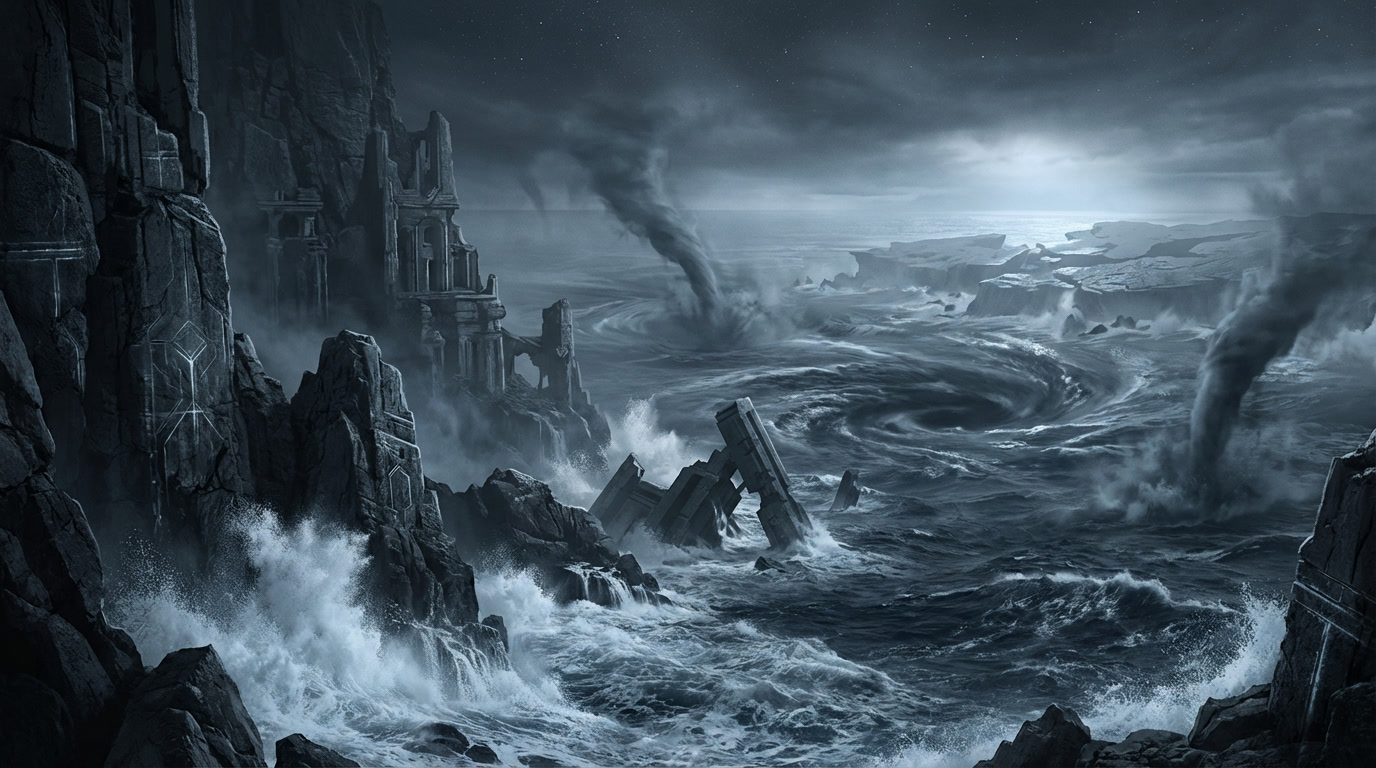
I. The Drowned Edge
The wind came first—cold and wet with brine, a knife running along the old bones of the shore. After the wind came the sea, and after the sea came the moment the world slipped and the boy fell through it.
Rongir Yur was five when Arcoros tried to swallow him. He remembered the grit in his teeth from the dune that overlooked the excavation site.
His father's bellow echoed from the ruin's black mouth—"Stabilizers, now!"—while sunlight sliced the ancient stones into harsh geometries.
His mother's touch—warm, gentle—when she brushed metallic strands from his eyes and told him to watch from the ridge and stay near the skim-craft. Her own V-fil hair chimed once against the sea breeze, and he remembered being glad of the sound. But it was the sigil that burned deepest in his memory: that shallow mark in basalt, neither triangle nor arrow, a shape that tantalized the eye with almost-meaning, a puzzle with no solution.
In the shadow of a fractured cliff, where Arcoros permitted a sliver of its sunken plateau to emerge, the archaeological team made their camp. They could not have known this continent had once been called Qu—a name preserved only by those who kept the old knowledge. From their perch on this meagre outcropping, none could grasp the immensity of the lost landmass beneath the waves. But all understood the sea's constant threat: its spiralling waterspouts, hungry maelstroms, and sudden cyclones that could devour their work in moments. Their instruments promised safety from these environmental afflictions for perhaps two days. Still, they lived with bags packed and eyes on the horizon, ready to abandon everything at the first wrong breath of wind.
To the Gamaen surveyors, it was a myth-reef that shed artifacts when the currents turned sympathetic—a rare chance for scientists to uncover treasures from the planet's most mysterious and perilous region. To Rongir, it was a field of stones where his mother hummed to herself and his father measured light. He was never supposed to have accompanied them—this was no place for a child—but his designated caretaker had fallen ill, and the rarity of opportunities to access this mystical place meant the expedition could not be postponed.
A tremor made the world lurch. Equipment skittered; someone laughed, short and nervous. Then the world paused, as if drawing in a breath, and held it. Then came the quake. It tore the excavation's metal framework into a maw of jagged angles. His father's scaffold rattled against ancient stone, a discordant percussion. Voices cut through the chaos—one calling for the anchors, another remembering the child on the dune. Then came the sea, carrying the weight of old promises, surging forward to claim the shore with a single, decisive sweep.
Rongir didn't run at first. He watched the ruin's mouth tilt, watched the trestles fold inward as if a giant hand wanted the structure back. The skim-craft was gone, and with it any chance at escape. He watched the sigil—that near-triangle, that unsolved edge—catch a pulse of blue and answer the sea with a soft, implausible light. Only when he heard his mother scream his name did he move, and by then the terrain had already decided to become a slope.
He didn't fall so much as slide down the dune, across wet sand, into a crack that hadn't existed a heartbeat earlier. The world became a catalogue of impacts: shoulder, knee, forehead. His palms found algae. His chest found water. The crack filled. The sea muttered to itself through stone. He learned a new rule under Arcoros: sound travels differently beneath fear. His mother's voice came thin and high from somewhere above. His father's voice came lower, like he was trying to bargain with the cliff. Then the ruin gave a sound he could never forget, a deep groan like a ship turning in its sleep, a crack pinched, and the boy's world narrowed to water and darkness. He felt compelled to move.
He started crawling. His mind had gone somewhere it didn't come back from immediately, and his body moved because it knew it had to. Reflecting on it later, he had no idea how far he'd moved, only that it had taken its toll in scrapes and bruises. He found a place where the crack widened enough to let him turn and rise. The water fell away, the dark thinned, and he surfaced into a cavern with a broken roof and a ragged window of light. In that light, the sigil returned, not carved but reflected, trembling on the ceiling like a thought he had almost had. It was everywhere and nowhere, an outline that insisted on being inside his head. He called desperately for his parents. Kept calling, pleading, crying—each voice a fragile thread in the storm's chaos. Only the sea answered, cold and indifferent, amplifying his sense of helplessness and loss. In the dark between calls, his own skin betrayed him, the faint violet pulse of the swirls on his cheeks throwing small, trembling shadows on the stone. At some point, the crying stopped because it wasn't doing anything, and he was very cold, and the sea didn't care.
Hours, or a whole lifetime, later, the storm ran out of anger, and the light outside decided it would forgive things by degrees. Rongir pulled himself onto a platform of broken slabs, wrapped himself in a torn thermal tarp, and watched the cave's mouth breathe. He did not sleep. He learned the sea's pattern instead; his ear tips swivelling in the dark, isolating each wave from the noise behind it, counting them until they had signatures, until the small high hiss at the end of each one was like a secret being kept.
By the time the search drones came, a skein of silver gnats humming across the surf, he had begun to hate the sound of his own name in his head. It arrived attached to the faces of loved ones he could not reach. He vowed no repeat.
He was not entirely alone when they found him. The cave had voices left by the sea—low, almost like the two-deep murmur of adults talking in another room. Sometimes he heard words. Sometimes numbers. Once, once only, a voice that did not sound like any Gamaen he knew said in a language he shouldn't have understood: Remember the shape of the deep. It came at the same moment a beam of low light cut across the cave and woke the sigil on the ceiling so that it flashed once, insistent as a heartbeat.
His rescuers were warriors, not civilians. When they stepped down from their gunship, Rongir did not flinch. He had run out of flinching, and he had decided that if the sea wanted him, it could come take him properly. The first warrior through the cave mouth wore armour scoured by salt and patience, its black plates etched with thin lines of crimson and deep teal. A second warrior held a staff with a modest emitter and an old grip. Their third counterpart, who did not speak at first, carried nothing in his hands and everything in his stance.
"Life sign," the first said, visor searching the thermal shadows. "Small. There."
The third warrior set his helmet on his belt. His face was ordinary in the way a well-made tool is ordinary—unfussy, purposeful. He crouched to make his eyes level with the boy's, and the eyes were violet, not by fashion but by birth, and full of a kind of weathered kindness Rongir would spend a lifetime trying to define. The swirl markings on his cheeks and temples—the same patterns Rongir bore, that every Gamaen bore—were perfectly tranquil.
"What is your name?" he asked quietly.
The boy considered the question with the seriousness he now carried like a limb. He did not immediately remember the word for himself. When it came, it seemed the cave issued it. "Rongir."
The warrior nodded, as if the boy had passed a test only he knew. "I am Teylan Vor," he said. "Forge Chief of the Kodon Order." He tilted his helmet toward the cave mouth, toward the slow sea. "We came for the dead. We found the living. The universe prefers a story that swerves." He offered the smallest smile. "Can you stand?"
Rongir stood up slowly but assuredly. The legends of the Kodon warriors barely registered through the fog of his grief. Under different circumstances, he might have gasped at their presence, might have counted himself blessed beyond measure that such revered figures had come for him. But the blessing offered little encouragement. The universe had taken everything familiar and replaced it with these armoured strangers who arrived too late to save what mattered. The boy who had played among excavation tools just yesterday was gone, washed away with his parents. He was smaller than he knew. Rongir's cadet-blue skin shivered under salt-brine as Teylan draped his cloak over him—no words, just shared silence heavy with absence.
When they led him out, he turned once in the cave mouth. The reflected sigil, weak now in the quieter light, hung one breath and went. He did not know why the loss felt like a promise.
Outside, the ruin's scaffold had collapsed into a shape that meant nothing. Drones traced careful arcs around bodies that the sea had decided to return. The Kodon were not loud. Their work had the pace of ritual, but not the pomp. The armour—charcoal black with crimson emblems and the faintest spiral of deep teal—looked like it understood both weight and water.
A young initiate approached Teylan and murmured. Teylan listened. He rubbed his thumb along the line of his jaw—a habit Rongir would later adopt without noticing.
"Commander," the initiate said louder, glancing at the boy, "Clause of the Sorrowed Ember?"
Teylan considered Rongir as if measuring him against the world and not finding him lacking. "Yes," he said. "If he chooses it."
Rongir learned the clause later. Orphans of ruin may be taken by the Forge, not as charity, not as debt, but as iron to be worked. Words escaped him then. He had only the cloak and the sensation of the armour's warmth against his bare shoulder when Teylan lifted him into the gunship's ramp and the sea dropped away.
He slept for the first time since the world had tilted. In the dream, he was on the dune again, and the wind had teeth, and the sigil in the ruin was a light set into a deeper dark, and the sea said remember, remember, but when he woke, he was on a bunk with a thermal blanket and the Kodon emblem carved into the bay's forward plate. It was a triangle—not perfect, never perfect—its angles soft as if smoothed by thumb and time. Deep in the etching, a dull metal bead, a different alloy, caught his eye. Someone had set a fragment here and forged around it. He reached out and touched it. It was warm.
"Better to be hammered than melted," Teylan said from the catwalk, like he was testing a proverb for fit. "Do you agree, Rongir?"
The boy nodded automatically, and then—because the clause required choosing—he nodded again, slower, from somewhere that had already decided.
II. The Forge of Becoming
The citadel at Kodon Ridge was a black thought set into a blue mountain, with emerald spires piercing azure peaks, sharp angles carved to defy erosion. From the approach pass, it looked like a spine laid onto stone. From inside, it was air, echo, and heat.
His quarters were sparse—a narrow cot, a basin hewn from mountain stone, and a window no wider than his palm that revealed nothing but air and distant water threading silver down the cliff face. Each dawn brought a new ritual. First came clothing, black as forge-coal and unadorned. Next, sustenance: steaming broth, dense bread, and a drink whose warmth lingered long after the cup was empty.
On the third day, when the mountain shadows still stretched long across his floor, Teylan himself appeared at the threshold, carrying two items in his weathered hands and wearing a question on his face. The objects were a wooden practice blade—scuffed smooth by a thousand hands—and a triangular shard, gold but not gold, the colour of old promises. The question was simple and absolute.
"Do you wish to belong to the Order?"
Rongir did not ask where his parents were, even though he grieved for them deeply. He wanted to ask. The question sat in his chest like a stone. But the sea had already answered it, and he had understood. Understood that bodies were a kind of weather, and weather changed. He did not ask about the shard. It felt wrong to ask before he had earned the right to understand.
"I do," he said, and the words fit in his mouth like bread.
Teylan placed the practice blade in his palm. He placed the shard in the other. "This was found among the wreckage of your camp," the Forge Chief said. "It is old. Older than our Order. We think our ancestors saw this shape and learned something from it. There are few like it. Keep it, if you want it. Melt it, if you choose it. Bury it. Return it to the sea. I do not care which. That choice is yours."
Rongir closed his fingers around the shard. The near-triangle, the not-quite arrow, bit his skin gently.
"What is it?" he asked.
"We do not know," Teylan said, and the answer struck the boy with more force than any claim of certainty could have. His parents had always had names for things. That was their science, the giving of names, the making of maps. Teylan offered no name. He let the object keep its mystery, and the boy understood, for the first time, that some things were more powerful that way.
III. The Trial of the Twin Doctrine
Rain came early to the ridge that day, starting as a gentle mist before intensifying with deliberate force. It carried the scent of molten stone and sap, the perfume of the mountain's patience being tested.
The initiates assembled at the Promenade of Echoes, a circular space above the white rapids pouring from the eastern opening of Kodon Ridge. Dozens of narrow platforms, no wider than a man's stance, floated on magnetic hinges that swayed and corrected with every gust. The Kodon called it the moving ground. To fall from it was not to fail, but to be reminded the world owed you nothing stable.
Rongir stood barefoot on the nearest platform, the river's breath rising in thin sheets of mist. Across from him waited Jareth Torain, a head taller, older by two cycles, braids bound in crimson wire, the colour of fire, the colour of impatience.
The duel was a rite known as the Trial of the Twin Doctrine. Each initiate embodied one aspect of the Kodon mantra: Fire that strikes. Ocean that endures.
Teylan presided in silence.
Jareth smirked. "I'll take the fire."
Rongir bowed slightly. He would not contest the inevitable.
"Begin," said Teylan.
Jareth moved first—fast and proud, a bright thing trying to be thunder. His strikes came in arcs that hissed through rain. He was stronger, but his rhythm was anger disguised as art. Most of Jareth's swings whistled wide, boots slipping on wet stone as rain slicked braids.
Rongir's lungs burned as he met each strike with calculated poise, staff parrying with wrist-flicks— deflecting high strikes to unbalance Jareth's centre. But fear and doubt crept through the shadows of his subconscious.
Jareth's staff whistled death—a blow to the temple could kill, to the throat might crush. Each impact vibrated up Rongir's arms like lightning, wood cracking against wood, the sound sharp enough to split the air. Pain bloomed where his defence failed: ribs screaming, shoulder joint wrenched backward, indigo blood trickling warm down his forearm.
Still, he retreated, each footstep precise on the rain-slick platform, the void of the falls roaring beneath. He tasted copper, felt his pulse hammering in his throat as he yielded ground deliberately—a predator's patience disguised as prey's fear—waiting for the moment when Jareth's rage would consume its master. The only question was whether he could deflect enough damage and hold long enough to outlast his opponent.
Jareth's bioluminescent markings blazed gold as he lunged again, all fire and fury.
To the spectators, it looked like surrender. Rongir kept losing ground and gaining welts.
To Teylan, it looked like the tide drawing back, only to make its inescapable return.
"Hold your ground, Yur!" someone shouted.
Rongir stepped aside from another swing, letting Jareth's own momentum carry him past. The older boy twisted, overcommitted. The platform groaned. Rongir pivoted low and swept Jareth's legs clear off balance. He didn't land a blow; he redirected one.
Jareth stumbled, caught himself, and snarled. "You mock the forge, boy!"
"I listen," Rongir said. "You mistake the hammer's noise for its purpose." He hadn't known he believed that until the words left his mouth.
Enraged, Jareth lunged again. Their staffs met, splintering. For a heartbeat, neither moved.
CONTINUE READING THIS STORY, AND OTHERS, IN THE COSMICFORGE ECHOES - VOLUME 1 ANTHOLOGY...