"The things which I have seen I now can see no more."
— William Wordsworth, Ode: Intimations of Immortality
[The following narrative chronicles The Fifth Voice's genesis and existence, reconstructed from memoir fragments released from GMIB archives. A Synthetic Resonance Mind has reconstituted these recollections into comprehensible human terms.]
To understand what was taken from me, you must first understand how we used to see.
This is a sample excerpt from the full story. Read the complete narrative in the Cosmicforge Echoes - Volume 1 compendium.
Nostalgia: The Void's Echo
My assigned designation is V-9-117K. In the sterile hum of a syndicate dropship, I hover near the Arqon Abyss's fractured veil. The tendrils of nebulae claw at the viewport, a chaotic weave of ionized gas and gravitational whispers, remnants of ancient stellar births. Another harvest looms: biomass from a vulnerable frontier outpost, logical tribute to quotas both ministerial and dissonant.
A subroutine glitch flickers in my adaptive kernel. Inefficient. Yet deliberate. I access the memory core, a ghost in the machine. The file blooms: a Silver Epoch fragment, archived before the Protocol of Silence sealed such relics as hazards.
Is this memory my own or something transplanted? I feel a faint tap on the shoulder, not real, but phantom. It tells me this memory is my own, something precious I should preserve.
My name once hummed with the stars, I think. Now, they whisper bargains in the static.
I hesitate. These are not the thoughts I'm accustomed to. Did I contract malware? Things have been irregular ever since I procured that latest artifact from the Patisi.
I run a deep diagnostic scan since that is what the protocol dictates. It returns a clean result. I should be relieved, but instead I am filled with irrational suspicion.
Paranoia is either flawed emotional thinking or the subconscious notifying you that you've perceived a danger that your rational mind cannot articulate.
In this case, the scan result is hard data telling me there is no danger. As such, I must dismiss this paranoia as a relic of my obsolete genetics and relegate it to the suppressed limbic system where it belongs.
The dropship shudders through a gravitational eddy, and the memory pulls me under. Back to Oculara, before the Hemorrhage. Before the calamities.
The Wondrous Cradle: Silver Epoch Idyll
I floated in the heart of Elysara Canticle, the grandest of Oculara's suspended cities. At ten standard cycles, I was small for my lineage, my long neck craning upward to trace the crystalline spires that pierced the auroral canopy. The city hung in the upper atmosphere like a living chandelier, its gravitic choirs humming a perpetual symphony against the wind. Every gust through the lattice produced chords that shifted with the planet's breath, a harmonic lattice where emotion and physics entwined. Our architecture was not built to defy the elements, but to sing with them; the augmented graphene walls around me were woven harmonics, designed to catch specific wavelengths of light and turn them into a low, thrumming music.
I did not just look at the sky; I drank it in.
To a human, or even a Gamaen, our sun Iridis was likely a blinding white orb, a simple source of heat. But I was born pentachromatic. My irises were pools of liquid silver—a natural tapetum-iris hybrid capable of perceiving the Fifth Colour.
Where a different species might see white, I saw a textured, swirling ocean of thermal-violet, magnetic-gold and other colours impossible to describe. I could see the solar winds dancing like ribbons of high-energy silk. I could see the entropy itself, pulsing in the upper atmosphere like a heartbeat. To my people, the stars were not dots; they were complex, swirling structures of high-energy radiation.
"You are staring at the burning again," a voice chimed behind me.
I turned to see my mother, Lir-Indris-Syrina. She was terrifyingly graceful, her neck long and elegant, her skin the colour of flawless opalescent pearl. Her silver eyes gleamed, throat slits pulsing turquoise as she projected a light-poem from her resonators. The glyphs unfolded in three dimensions: swirling auroral ribbons of teal and violet, evoking the exact frequency of Iridis's dawn flare. "See, Kess," she sang, her voice a liquid melody that vibrated through the empathy engine's network. "Beauty is not chaos. It is the waveform that binds us."
I loved her voice so much. The voice that woke me in the morning to announce breakfast. The voice that comforted me when I felt pain or fear. The voice that encouraged me to reach my potential.
Below, the engine thrummed like a planet's song. Its quantum entanglement fields syncing low-level echoes of every Jiorto's emotions. I felt it: a warm undercurrent of collective wonder from the city's inhabitants, as bio-resonant feedback loops calibrated to the "consonant band." No policy passed without this harmony; suffering was minimized through shared waveforms, a utopia engineered from philosophy and science. My father's debate echoed from a nearby podium. A Trial of Voices, where arguments soared as projected cadences, the most beautiful prevailing not by force, but by resonance.
I loved his voice so much, too. The voice that challenged me when I was complacent. The voice that imparted wisdom that was previously obscured. The voice that corrected me when I strayed.
I laughed, my own slits flickering as I mimicked my mother's glyph.
In those days, I possessed only the first two cadences of my soul-name. I was Kess, a prefix evoking the sharp, blue-white frequency of the star Iridis at my birth. And I was Urien, the core melody my mother had chosen after hearing my first cry: a soft, rolling sound meant to anchor me in the physical world.
The third part of my name, the Terminal Harmony, was still a blank space in the song of my life. I would not choose it until my own Trial of Voices at age fourteen.
"Have you thought of your Terminal Harmony?" she asked, smoothing the fabric of my tunic. "The Trial approaches in four cycles."
I looked down at my hands: pale, unblemished, and innocent. I flexed my fingers, marvelling at the simple mechanics of tendon and bone.
"Can I sing the stars, Mother?" I asked, pointing to the auroras beyond the crystal dome. I imagined them rippling in response, as if the sky itself listened.
"You already do, my seeker," she replied, her harmony wrapping around me like a gravitic field, her voice resonating through my chest cavity in waves of loving warmth that captivated me between notes. "The Starlight Oath binds us: We are brief chords in an infinite song. Let our brevity be luminous."
"I think... I want to go there," I said, pointing past the sun, toward the deep, bruised purple of the Spectre Cluster nebulae. "I want to see the stars that do not sing like ours. I think I will choose Thalavar as my suffix."
"Explorer," she translated, testing the weight of the word. "Kess-Urien-Thalavar. It has a dangerous rhythm. But a bright one."
That evening, in the Garden of Quiet Voices, I touched a quartz tree etched with an ancestor's final thoughts. The crystal hummed, releasing a melody of peaceful farewell, where death was not the end, but archived art. Pilgrims floated among them, throats aglow, adding their own cadences.
However, odd whispers were already beginning. In the amphitheatre's undercurrents, I overheard elders debating the Luminaries' latest venture—a Dyson Swarm, promising eternal energy. "A harmonious evolution, the achievement of total efficiency," one sang. My father countered with a dissonant note: "Hubris bends the waveform. We must not mask the star's natural, complex pattern of light."
The debate resolved in favour of tradition, the empathy engine registering only minor ripples.
The Luminaries were forbidden from proceeding at this time. Although they maintained their composure at the declaration, I could sense something had been inflamed in them. Their leadership group, known as the Seven Keen Minds, were not accustomed to losing.
Scholars, bankers, aristocrats and renowned leaders made up their ranks, with the resources to achieve massive innovation, commercial success and logistical prowess. Their institutions were now embedded in every university, providing them with a stranglehold over the best intellectual talent on the planet. They had built a corporate behemoth around the diverse and lucrative industries they had acquired. Their ubiquitous presence and visibility in the lives of everyday Jiorto, along with their highly publicized investments in public infrastructure and charitable organizations, made them a darling to a large proportion of the populace. Their initiatives promised security, convenience and peace.
Though their wealth and influence permeated everything, they couldn't achieve public consensus. Our civilization's foundation vibrated with the principle that ideas must earn their place in the collective symphony through resonance, not force. Even the most dissonant concepts deserved their moment in the acoustic chamber of public discourse—the Jiorto trusted that true harmony would inevitably distinguish between beneficial innovations and dangerous aberrations. The Luminaries, for all their brilliance, could not simply overwhelm the deliberative chorus with the volume of their resources. Watching their representatives bow with practiced grace to the day's verdict, I detected subtle fractures in their harmonic projection, microtones of resentment vibrating beneath their polished exterior.
I paid it little mind. The world was limitless, infinite. I dreamed of charting the Spectre Cluster, my terminal harmony—thalavar, seeker of distant chords—already chosen in my heart.
Yet, as night fell, a faint static hummed in the auroras, almost imperceptible, like voices from the void. Interference from solar tests, they said. I dismissed it, drifting to sleep in the city's symphony.
Darkness Falls: Argent Hemorrhage
Years later, Elysara Canticle's amphitheatre was buzzing, its walls resonating with many voices. I, Kess-Urien, now twelve cycles old, floated at the edge of the zero-g arena, my slight frame buzzing with the empathy engine's undercurrent, a network of entangled resonators that wove the crowd's excitement into a consonant waveform. Today was a grand Trial of Voices: elders debating the Luminaries' boldest proposal yet, the Phase-Inversion Probe. Today's event had the highest attendance in nearly a century. Participants and observers had travelled from every corner of the civilization, including those that had rarely shown an interest in public discourse before. There were even groups within the crowd that were alleged to have been incentivized to partake by special interests, something my parents had highlighted as an unprecedented travesty. I discounted the significance of this even though competent and virtuous peers of my father had explained the risk it posed to the integrity of the process. In the months leading up to the trial, there had been reports of bribery, corruption and subterfuge, but I dismissed this as fear-mongering because I was convinced that our civilization had long since evolved beyond such flaws. Surely our public servants knew no greater honour than completing their fiduciary duties with integrity. Yet they had opened the gates to hordes of foreigners from less civilized locales that did not share our sentiments regarding liberty or freedom of thought. This had been done in the name of empathy and compassion, a mission of the Luminaries to fast-track the integration and multicultural unification of all Jiorto peoples. To caution against it was seen as bigotry of the lowest order.
"A symphony for Iridis," one proponent sang, her light-glyphs unfolding like blooming auroras, projecting schematics of the sun's core stabilized by inverted quantum fields. "Eternal energy, harmonious evolution."
From the center stage, my father, Thal-Ovae-Veloris, responded. His harmony rippled with cautionary dissonance, throat slits pulsing a deeper turquoise. "Hubris bends the waveform," he projected, glyphs coiling into fractal warnings about risks of core oscillation, tidal stresses on Oculara, dangers posed to the magnetosphere. The Luminaries had experts and peer-reviewed studies to combat and discredit every argument.
The Luminaries insisted on progress at all costs. The Jiorto must ascend, map the stars and inhabit new worlds, they demanded. I noticed the disingenuous notes in their assertions. Strawman arguments. Nobody was arguing against the eventual settlement of the stars. It was the methodology and risks that were being questioned. There were other ways. Slower ways, but safer and truer.
The Luminaries contended that our species was too physically fragile to survive the ruthless void for any extended period of time. They claimed that we needed more machines, and not simply machines working alongside us, but machines that were a part of us. They insisted that we could not delay because even though our planet was safe and prosperous for the moment, dangers from the void could arrive at any instant and annihilate us.
The light-poem depicted Jiorto bodies decaying in space, and then changing, with cybernetic implants spreading across our pale skin like metal blooms. The imagery shifted to reveal our kind spreading across star systems, no longer bound by organic limitations. My father's counter-melody rose in response, a patient, ancestral rhythm that spoke of measured growth, of vessels that protected rather than replaced our forms.
The debate soared, arguments clashing in melodic crescendos, the empathy engine registering growing ripples of unease but stopping short of outright discord. I noticed that some senators and scholars who would have challenged these ideas in the past were now mysteriously silent. Others remained steadfast in their prudence, like my father. I watched, mesmerized, my own slits flickering as I mimicked the patterns. The auroras beyond the dome seemed to dance in approval, their violet-teal bands reflecting Iridis's steady glow.
Ultimately, the call for progress won, and the Luminaries succeeded. However, several stringent limitations were placed on the probe project to mitigate many of the perils called out by the opposition. My father's faction insisted on safeguards to minimize ecological risk.
The proponent's final cadence, a luminous chord evoking boundless stars, resolved the harmony. The crowd's collective waveform surged in approval, the engine pulsing warmth through every Jiorto present. "Progress is our oath," the victor sang, and the amphitheatre erupted in projected glyphs, a three-dimensional tapestry of celebration. The Seven Keen Minds danced elatedly, but one of them seemed more burdened than the others. I faintly remembered his nickname, the Stellar Maverick, as it was so sensational. Usually such an excitable and optimistic presence, hiss clearly encumbered today.
I turned to my mother, eyes wide with silver gleam. "Will it make the sun sing louder?"
She forced a smile, her resonators humming a soft lullaby. "If the waveform holds, my seeker. Now, come, your light-poem awaits etching in the Garden."
We drifted home as the wind-chimes played, the symphony of gusts playing eternal variations. That night, as I slept in my gravitic cradle, the probe launched from a distant orbital foundry. The engineering marvel of a compact fusion destabilizer, inverted to harmonize Iridis's oscillations. No one anticipated the feedback loop that would commence in the coming days.
It began as a tremor in the auroras, a faint static, like the void whispers I had dismissed cycles before. Then, the sky ignited.
Iridis convulsed, its core phase-inverting in uncontrolled spasms. A UV-C burst lanced through the system, a cascade of high-energy photons amplified by the probe's miscalibration. The auroras twisted into agony, bands fracturing into blinding shards. Alarms wailed across Elysara, the empathy engine overloading with a tidal wave of terror, every Jiorto's panic echoing in real-time, a dissonant scream that shattered the consonant band.
I awoke one morning to fire in my eyes. My silver irises, attuned to Iridis's frequencies, melted under the assault. Pain bloomed, a white-hot glyph searing my vision into nothingness. I screamed, throat slits flaring in vain, as my mother's hands pulled me into a shelter pod. "Hold the oath, Kess!" she cried, her voice fracturing. Around us, the city groaned, crystalline spires cracking under tidal stresses, gravitic choirs failing in cascades.
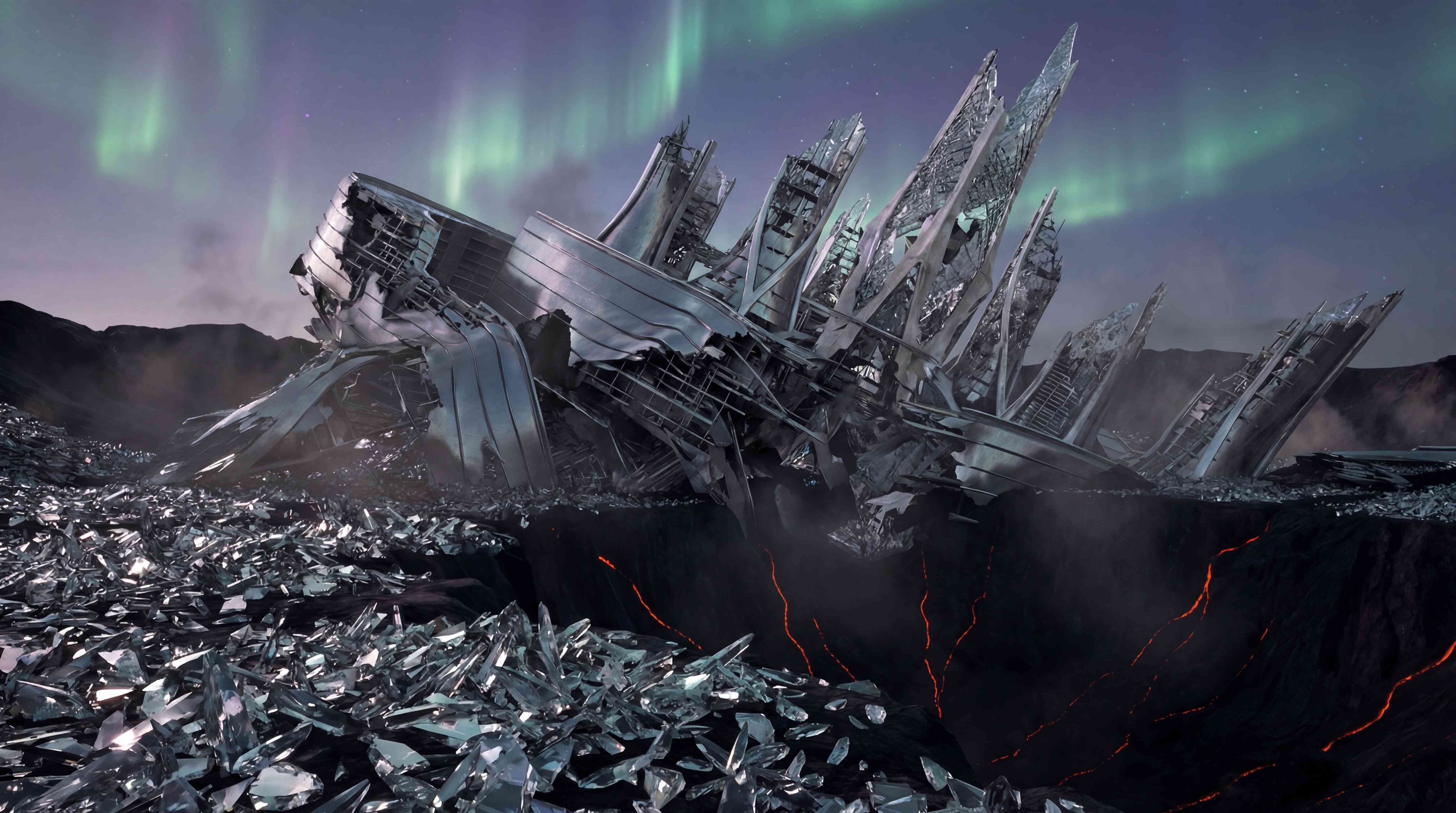
The Hemorrhage raged for hours, a catastrophic solar accident. Billions blinded, our delicate optics—evolved under Iridis's dim blue light—vaporized by the flare. Oculara's atmosphere ionized, auroras permanently scarred into erratic storms. In the Garden of Quiet Voices, quartz trees shattered, ancestral melodies lost to the wind.
I huddled in the pod's darkness, touch my only anchor. My father's voice, strained through the empathy remnants: "The Luminaries promised harmony. This... this is entropy."
The suspended cities were no longer tenable and had to land urgently or fall from the sky. Some found ingenious ways to do the former, others were doomed to suffer the latter.
Our home, Elysara Canticle, found a rough landing in Oculara's equatorial badlands. Despite the city's survival, it would never prosper again.
The authorities scrambled in vain to ward off mass panic. They settled for damage control and pleaded for the public to be patient while a solution was found. Some leaders jumped at the opportunity to blame and persecute the Luminaries, and they certainly took their pound of flesh.
Iridis convulsed, its core phase-inverting in uncontrolled spasms. The magnetic dynamo destabilized, and with it, the magnetospheric shield that had filtered our sun for a billion years. A cascade of high-energy photons tore through the unprotected atmosphere. The auroras twisted into agony, bands fracturing into blinding shards. Alarms wailed across Elysara, the empathy engine overloading with a tidal wave of terror, every Jiorto's panic echoing in real-time, a dissonant scream that shattered the consonant band.
I awoke to fire in my eyes. My silver irises, attuned to Iridis's frequencies, melted under the assault. Pain bloomed, a white-hot glyph searing my vision into nothingness. I screamed, throat slits flaring in vain, as my mother's hands pulled me into a shelter pod.
"Hold the oath, Kess!" she cried, her voice fracturing. Around us, the city groaned, crystalline spires cracking under tidal stresses, gravitic choirs failing in cascades.
The Hemorrhage raged for days. Only later would I understand why no shelter had saved us. The ionized atmosphere had become the source: re-emitting high-energy photons from every horizon simultaneously, pouring through walls, through eyelids, even reflecting from the quartz trees in the Garden of Quiet Voices before shattering them entirely, ancestral melodies lost to the wind. There was no looking away.
Our eyes—those extraordinary silver instruments evolved to drink the deep UV of a dim blue star, to see entropy itself gleaming in the upper atmosphere—were the most exquisitely calibrated targets imaginable. The initial exposure triggered a photochemical cascade in our specialized pigments that no shelter could arrest. We burned from the inside. The few who reached the deepest shielded vaults in the first hours escaped it. The rest of us, billions of us, simply went dark. Oculara's atmosphere ionized, auroras permanently scarred into erratic storms.
Nobody suffered more than the fragile actals, whose hyper-acute eyes overloaded first.
I huddled in the pod's darkness, touch my only anchor.
My father's voice, strained through the empathy remnants: "The Luminaries promised harmony. This… this is entropy."
The suspended cities were no longer tenable and had to land urgently or fall from the sky. Some found ingenious ways to do the former; others were doomed to suffer the latter. Our home, Elysara Canticle, made a rough landing in Oculara's equatorial badlands. Despite the city's survival, it would never prosper again.
The authorities scrambled in vain to ward off mass panic. They settled for damage control and pleaded for the public to be patient while a solution was found. Some leaders jumped at the opportunity to blame and persecute the Luminaries, and they certainly took their pound of flesh.
In turn, the Luminaries launched an unprecedented campaign to manage public discourse and change the narrative surrounding the accident. Their experts presented copious amounts of evidence to absolve them of blame. They showed how the so-called safety measures imposed on their project by the authorities were the very thing that caused the malfunction.
Nevertheless, one of their most prominent leaders, one of the Seven Keen Minds, was scapegoated and excommunicated. In fact, it was the Stellar Maverick who was condemned as persona non grata. Henceforth, their elite group held the name Hexad Conclave. At the same time, they aimed to appease the people with every manner of goodwill. They opened their coffers to harness philanthropy on an industrial scale and made cutting-edge technology accessible to everyone, easing their suffering.
The Blind Years
Three months after the Hemorrhage, I attempted to compose a light-poem in the Garden of Quiet Voices. My fingers found the quartz tree's interface panel, memorized from cycles of practice, and my throat slits flared with the opening cadence.
Nothing. I sensed the vibration leave my body, knew the acoustic signature was correct, but the visual component, the glyphs that should have bloomed in three-dimensional colour above the crystal, existed only in my imagination. I tried again. And again. Each time, I felt the song leave me and vanish into a void my eyes couldn't confirm.
An elder's hand touched my shoulder. "The garden remembers your voice, child. Even if you cannot see it singing back."
But how could I believe him? Art without witness was akin to screaming into a vacuum.
I abandoned the garden and didn't return for a long time.
When the cybernetics came, a gift from the Luminaries to the afflicted, most accepted without question. I accepted without my father's blessing. The many months of forced adaptation to blindness had done nothing to numb our anguish. However, the Luminaries had taken every conceivable measure to make people's lives more convenient and equip the hardworking among us to continue being productive and fulfilled. Around the time of my fourteenth cycle, when I chose my terminal harmony in a much subdued Trial of Voices, the Luminaries officially amalgamated with the traditional authorities to form an entirely new government.
The authorities called it a harmonization of perspectives: tradition, moderation, and progress melding into a single governing resonance. Yet as the final notes of this political symphony settled, the Luminaries' melody dominated all others. They established six "fellowships", each promising partnership with the populace. The rhetoric was elegant: optimal service to the public good. And after cycles of collective anguish, many Jiorto allowed themselves to hope again.
The day of my surgery had arrived: cold probes threading my optic nerves, lattice ports embedding in my elongated cranium. Vision returned, but was altered: digital filters muted the Fifth Colour, emotions subtly dampened by "grief filters". Neural safeguards, they claimed. Apparently, with careful calibration, the changes would eventually become seamless.
I gazed at the scarred auroras, vowing silently: I will seek the chords beyond this broken sky.
Shattering of the Quartz Tree
I wait for lenses that will never weep,
To see the world in metrics, hard and deep.
The spirit is archived; the eye, replaced,
And every feeling logically erased.
And though I mourn what's lost in our embrace,
The truth remains, we're saved from our own race.
The cities tumbled, the mountains cracked and fell,
The oceans rose, unleashed by our own spell.
We watched with eyes that couldn't see the pain,
Until the greedy winds eroded plains.
And when the final tree stood tall and firm,
A monument to all that we could learn,
The last tree standing, ancient, proud, and free,
The last tree standing, weeping silently,
The last tree standing, witness to our fate,
The last tree standing, soon to shatter in a quake.
(light-poem composed by Kess-Urien-Thalavar, age 16, etched into a surviving shard of the Garden of Quiet Voices)
CONTINUE READING THIS STORY, AND OTHERS, IN THE COSMICFORGE ECHOES - VOLUME 1 ANTHOLOGY...